
Guide
Risk management for crypto trading
Position sizing, leverage, stop distance, liquidation risk, and daily loss limits for the strategies above.
Disclaimer and responsibility
- The scenarios in this guide are educational examples, not financial advice and not a promise of profit.
- WatchlistTop can help structure market analysis, but every concrete trading decision is made by the trader.
- The trader is responsible for position size, leverage, stop placement, exchange risk, liquidation risk, and the consequences of each trade.
- Crypto assets and futures are high-risk markets. A strategy can produce losses even when all screener conditions look valid.
Market
All strategies. Especially important on futures because leverage and liquidation can turn a small mistake into a large loss.
Timeframes
- Risk is not tied to one timeframe. It is tied to the distance between entry and invalidation.
- Higher timeframe setups usually require wider stops and smaller position size.
- Lower timeframe scalps can use tighter invalidation, but execution and spread become more important.
Screener tools
- Ruler tool for stop distance and target distance.
- "NATR" to understand current volatility.
- Levels and trends to define invalidation.
- Exchange-account markers to compare planned and actual risk after the trade.
Basic setup
- Before entering, define the exact price where the trade idea is invalid.
- Measure the distance from entry to invalidation. This is the stop distance for position sizing.
- Choose account risk first, for example 0.25%, 0.5%, or 1% of account equity per trade.
- Position size is derived from risk amount divided by stop distance, not from how confident the setup feels.
How to read the setup
- Example: account is 1,000 USDT, risk per trade is 0.5%, so planned loss is 5 USDT. If invalidation is 1% away, the notional position is about 500 USDT before fees and slippage.
- With futures leverage, notional position and margin are different. A 500 USDT notional position at 5x uses about 100 USDT margin, but the trade risk is still based on stop distance.
- If liquidation is closer than the logical stop, leverage is too high for the setup.
- Stop-loss distance is always set by market structure — behind a level, trend line, or reaction candle. What changes between trading styles is the risk per trade, not the stop placement logic. An aggressive trader takes a larger position at the same stop, not a tighter stop.
- Stop distance should not be smaller than roughly 0.5× the current "NATR" value. A tighter stop will be hit by normal candle noise before the setup has a chance to play out.
- R:R (Risk:Reward) is the ratio of potential profit to planned loss. R:R 1:2 means the target is twice the stop distance: if the stop is 1% from entry, the minimum acceptable target is 2% from entry.
- Conservative style: 0.25–0.5% risk per trade · daily loss limit 1–2% · minimum R:R 1:2.5 · leverage up to 5× · pause after 2 planned losses.
- Normal style: 0.5–1% risk per trade · daily loss limit 2–3% · minimum R:R 1:2 · leverage 5–10× · pause after 3 planned losses.
- Aggressive style: 1–2% risk per trade · daily loss limit 3–5% · minimum R:R 1:1.5 · leverage 10–20× · pause after 3–4 planned losses.
- Take-profit: place it at the next meaningful level or liquidity area rather than at a fixed percentage. The minimum acceptable target is R:R × stop distance from entry.
When to skip
- Do not use the same position size on coins with very different volatility.
- Do not increase position size after losses to recover faster.
- Do not remove the stop because OI, funding, or the orderbook still look convincing.
Risk management
- Use a daily loss limit. Example: stop trading for the day after 2-3 planned losses.
- Reduce size during news, extreme funding, very high "NATR", and thin orderbook conditions.
- For counter-trend trades, use smaller risk than for setups with higher-timeframe trend support.
- Treat fees and slippage as part of risk, especially on fast scalps.
Screenshots
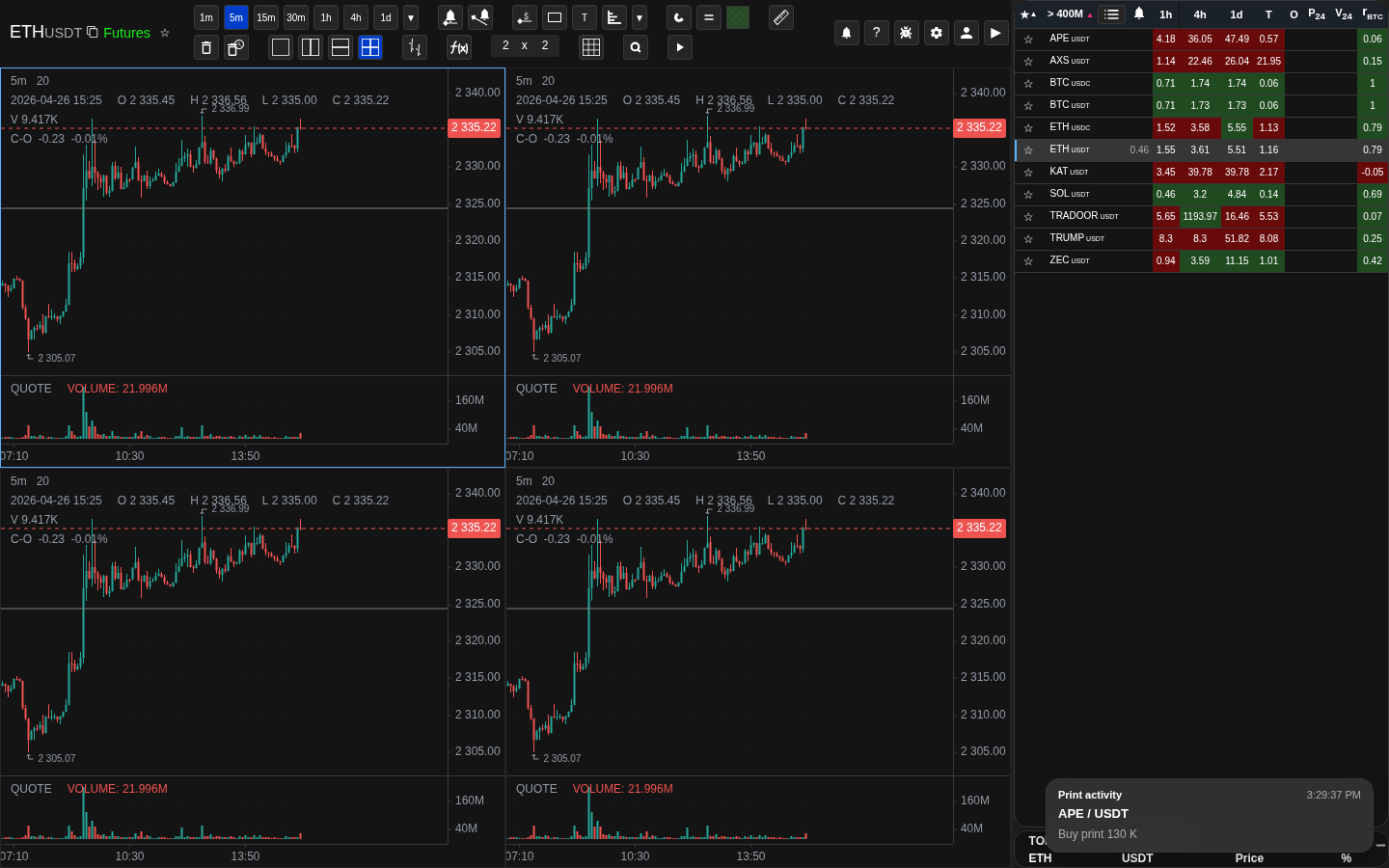
Ruler and distance
Measure stop distance before calculating position size.
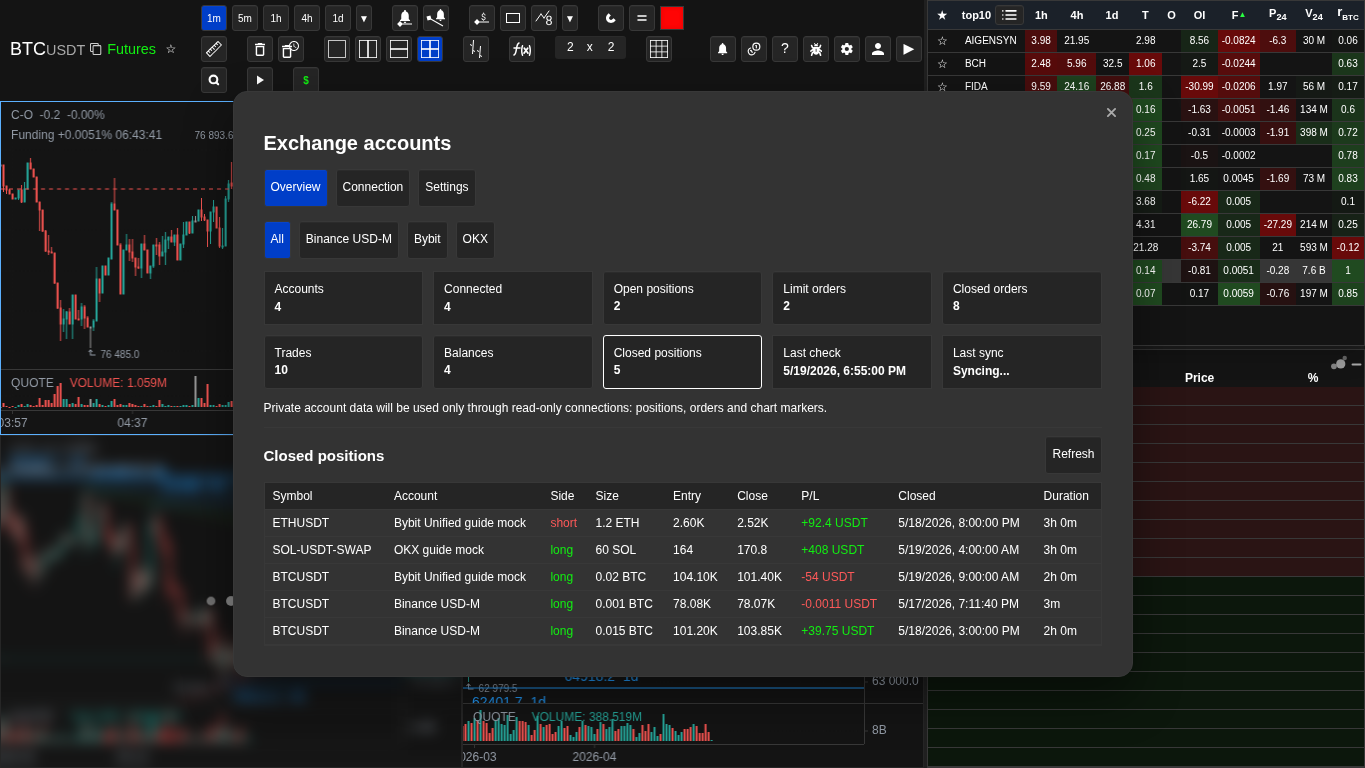
Review actual outcomes
Use closed-position data to compare plan and execution after the trade.