
Guide
Chart patterns as a filter
Use detected patterns as a reason to inspect a coin, not as an automatic entry signal.
Disclaimer and responsibility
- The scenarios in this guide are educational examples, not financial advice and not a promise of profit.
- WatchlistTop can help structure market analysis, but every concrete trading decision is made by the trader.
- The trader is responsible for position size, leverage, stop placement, exchange risk, liquidation risk, and the consequences of each trade.
- Crypto assets and futures are high-risk markets. A strategy can produce losses even when all screener conditions look valid.
Market
Spot and futures. Works best when the pattern appears near a meaningful level or liquidity area.
Timeframes
- Pattern context: 1h, 4h, and 1d are more reliable than very low timeframes.
- Entry refinement: 5m or 15m after confirmation or failed confirmation.
- Use lower timeframes only after the higher-timeframe pattern gives context.
Screener tools
- Chart pattern overlays.
- Levels, trends, OI, funding, and volume for confirmation.
- Alerts near pattern confirmation lines.
- Ruler tool to estimate potential move and invalidation distance.
Basic setup
- Enable pattern detection only for the timeframes you actually use.
- Keep confirmation-only mode enabled if you do not want forming patterns to distract you.
- When a pattern appears, check whether it aligns with a level, trend, OI change, or volume expansion.
How to read the setup
- A pattern has more value when it explains where the market can invalidate a move.
- Do not trade a pattern in isolation. Combine it with price reaction, volume, and market structure.
- A failed pattern can be useful too: failed bearish pattern can become bullish continuation and the opposite is also possible.
When to skip
- Avoid low-score patterns that do not align with any level or activity signal.
- Avoid interpreting every shape as a pattern on low timeframes.
- Do not ignore volatility: a pattern with a very wide invalidation can be unusable for your risk limit.
Risk management
- Risk should be placed around pattern invalidation, not around the visual label.
- If the target is smaller than the stop distance, the pattern is not attractive even if it looks clean.
- Reduce size when the pattern is against a strong higher-timeframe trend.
Screenshots
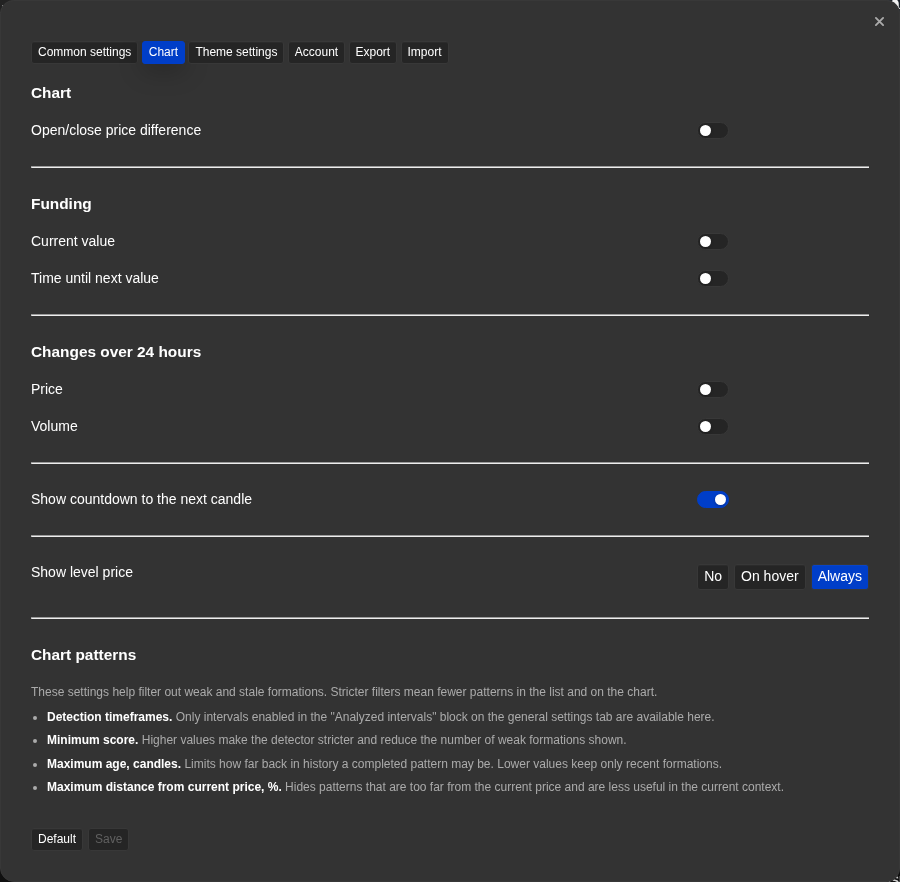
Pattern and algorithm context
Pattern overlays should be checked together with metrics and levels.
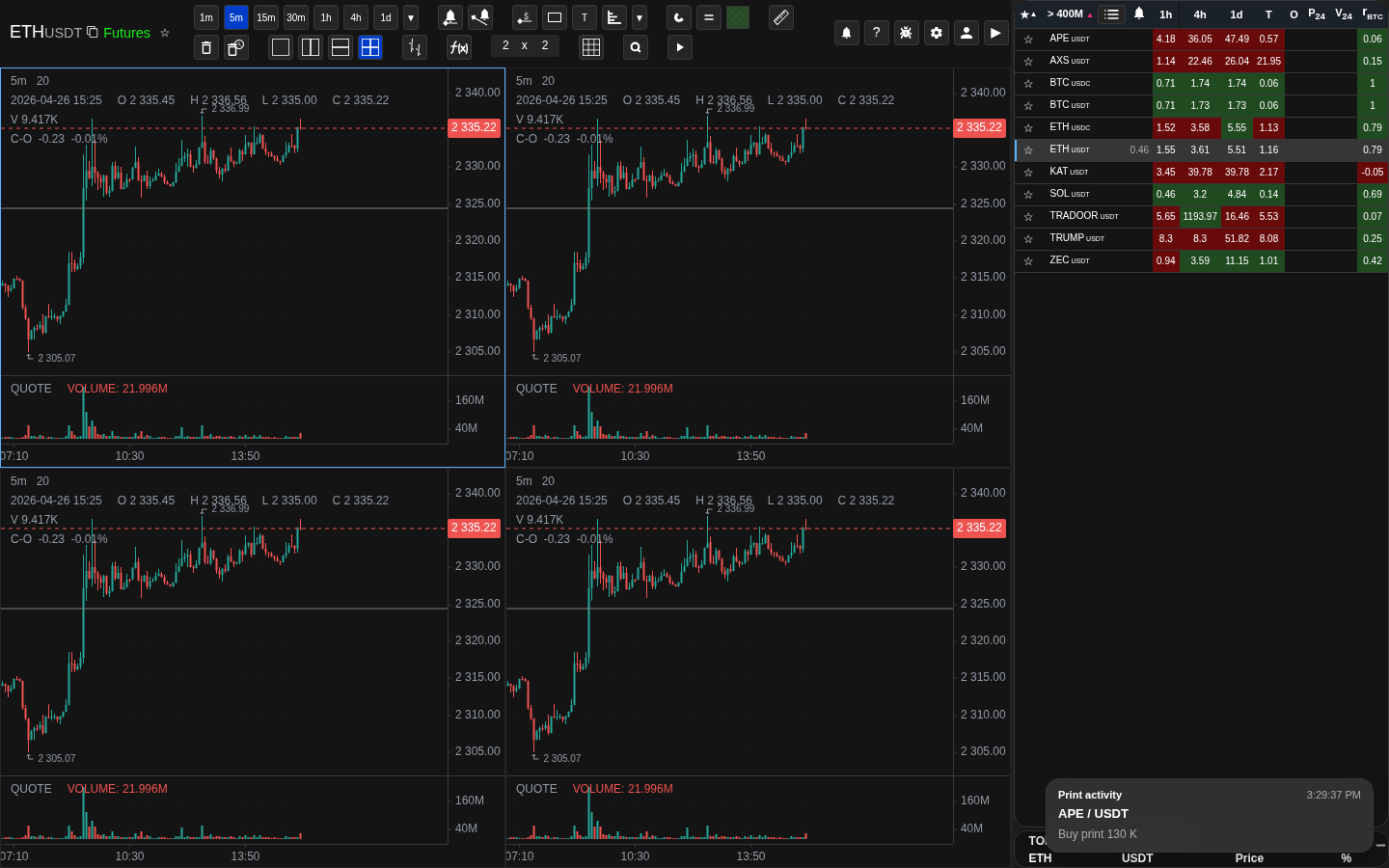
Ruler for risk distance
Use the ruler to compare potential move with invalidation distance.